Ukraine’s East Sees Biggest Escalation in Five Months

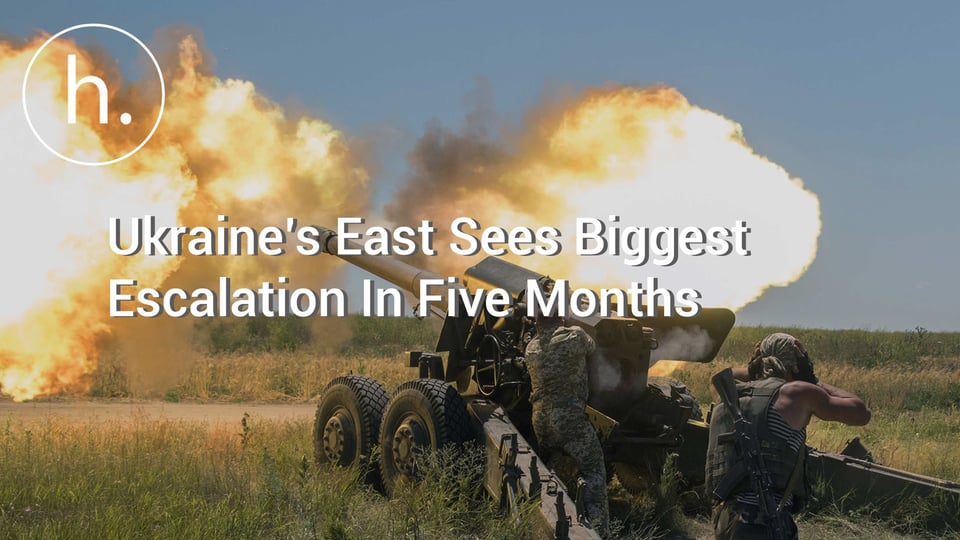
The past few weeks have seen some of the heaviest clashes in eastern Ukraine since the start of the year. The amount of shelling, fighting, deaths, and injuries from fighters and civilians on both sides of the contact line marked a five—month record. Hromadske – on behalf of Russian independent news site Novaya Gazeta – investigates the questions of what and why is happening in Donbas.
The past few weeks have seen some of the heaviest clashes in eastern Ukraine since the start of the year. The amount of shelling, fighting, deaths, and injuries from fighters and civilians on both sides of the contact line marked a five-month record. The starting point for this wave of clashes was April 30. Hromadske – on behalf of Russian independent news site Novaya Gazeta – investigates the questions of what and why is happening in Donbas.
April 30 marked the official end of the Ukrainian government's “Anti-Terrorist Operation” (beginning in April 2014), which has been replaced by the Joint Forces Operation (JFO). This was signed in by President Petro Poroshenko in the 2018 Law, “On the peculiarities of state policy on ensuring the state sovereignty of Ukraine over the temporarily occupied territories in the Donetsk and Luhansk Regions.”
As a result, the Joint Forces Operation took control of the village of Pivdenne (Chihiri), located in the “gray zone” (territories to which both sides of the conflict make claims in ways including military) of the Donetsk region.
The operation was carried out by the reconnaissance-sabotage group of the 46th Separate Special Purpose Battalion “Donbas”, which constitutes a part of a brigade of the Ukrainian Armed Forces (UAF). As a result of the May 20 clashes, one Russia-led separatist was killed and three more had been captured.
“That’s how the clashes along the whole front line had started,” says Hromadske journalist Nastya Stanko who has been covering the conflict in Eastern Ukraine. “The Ukrainian Armed Forces are trying to secure their position.”
Representatives from the JFO headquarters stress that they do not use heavy munitions, while observers from the Organization for Security and Co-operation in Europe, or OSCE, remark that violations had taken place on both sides of the contact line, especially in areas where the sides are close to each other. This includes the Svitlodarsk arc, the proximity of the destroyed Donetsk airport, and the areas near Horlivka city. According to the Minsk Agreements of 2014, these territories belong to Ukraine.
“The use of heavy artillery in these areas is always an indicator of heightened aggression,” stated Alexander Hug, first deputy head of the OSCE Special Monitoring Mission in Ukraine. During one of the missions’ reports, Hug called this a “senseless and endless cycle of violence"
"Both sides claim to be returning fire. No one knows who started it,” he said.
Everyone has recognized the escalation of hostilities: in the JOF, OSCE, and occupied territories.
On May 17, Dmytro Hutsulyak, spokesperson for Ukraine's Ministry of Defense, announced that fire from the occupied territories had consisted of 122 mm caliber artillery and 120 mm caliber mortar against the settlements of Troitske, Novoluhanske, and Zaytseve in the Donetsk region. He stated that “Units of the Join Operations Force are carrying out active defense and had returned fire 11 times with large-caliber arms and small arms.”
Between May 12 and 19, two soldiers of the Ukrainian Armed Forces had died, 11 were wounded.
OSCE observers report that Horlivka stood as the center of the May escalations. Between May 17 and 18, they recorded 140 explosions, mostly from artillery and tank shelling.
On the morning of May 21, Russia-led separatists had announced that a shelling of Horlivka in Donetsk region took place. The Donbas battalion had informed Hromadske that “there are currently clashes on the frontline towards the occupied territory of Horlivka.”
At least two dozen civilians had been injured and four dead (including a 13-year old child) within the Ukrainian-controlled territory. Just as many casualties are reported on the other side of the contact line.
Yevhen Kaplin, head of the humanitarian mission “Prolisok,” told Hromadske that over 150 houses had been destroyed or damaged as a result of the aggravation of hostilities.
Alexander Hug notified the Atlantic Council that from the moment of the signing of the Minsk Agreements, there had been no desire or political will to comply with the points prescribed in the treaty, be it the removal of arms, mines, and creating safe travel corridors for OSCE observation missions.
“The surge [of armed conflict], which we see, reflects a further decline in political will towards the realization of the Minsk agreement,” Hug states.
He noted that over the course of the last week there had been over 7,000 recorded instances of breaching the ceasefire, which is 40% higher than the previous week. Likewise, the mission observed the presence of 41 different types of restricted weapons, equipment, and presence of personnel near the line of contact.
“Access to the conflict zone for journalists exists according to several rules which were established two years ago. They include accreditation, press cards, and a planned route, which should be submitted a few days before the trip,” Hromadske journalist Anna Tokhmakhchi says. “However, you can still be denied access, which is decided by the commander of the local brigade or battalion, for whom it’s sometimes easier not to grant access. There are times when one has to resort to persuasion, even when they only need to go to civilian areas, not military ones. But these are the rules [in front-line villages]: only local people with a local residence permit are allowed”
The government has not explained the current situation, journalists have to learn about it from the daily reports of the headquarters.
“With the beginning of the operation of the Joint Operations Force, a new rule has been put in place: the creation of “red zones”, which signify the prohibition of entry and movement in a particular area. But this state only lasts several hours, for instance, in controlled access zones (through the demarcation line), when the operation receives information about a potential clash. The “red zone” is then put into place, and is removed several hours later, whereupon the checkpoint operates normally,” explains Tokhmakhchi.
Kyiv Post reporter Ilia Ponomarenko thinks the escalations in Donbas exist as part of a larger scenario of this extended war.
“There is now an ongoing struggle for advantageous observation points, new hidden anchor points, or comfortable sniper positions, and areas where to place mines and traps on the strip that separates both sides,” he said.
“If you don’t capture a destroyed house lying on a hill from which you can better observe your enemy, then the enemy will do so, and your observation posts will be in greater danger. You need to be able to somehow prevent this. As a result, a fatal game of cat and mouse forms, which helps you survive, but civilians inevitably suffer as a result,” Ponomarenko stated to the Atlantic Council.
/By Yana Sedova
/Translated by Vladislav Yakovlev