'In an entire city, it was Serhii who was killed'. Paramedic from Kherson region dies in second Russian drone strike

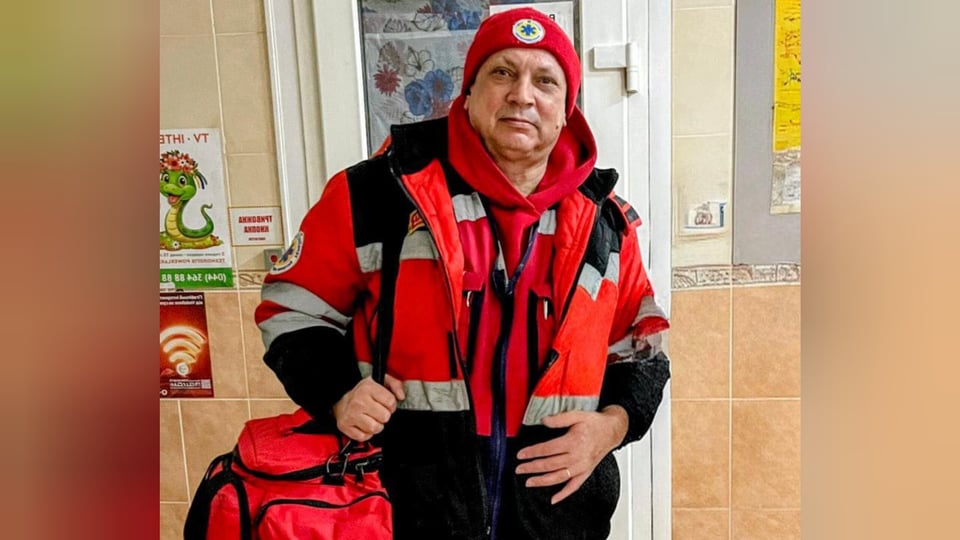
On the night of January 9, during a Russian attack on Kyiv, emergency medical worker Serhii Smoliak was killed. He and his colleagues had arrived to provide assistance to residents of a high-rise building in Kyiv’s Darnytskyi district that had been hit by a drone.
According to Physicians for Human Rights, since the start of Russia’s full-scale invasion more than 2,000 attacks on healthcare facilities in Ukraine have been documented, and more than 300 medical workers have been killed. Memories of the medic who died while saving the lives of others — in a report by Oleh Baturyn from the Public Interest Journalism Lab.
“We learned that a medic had been killed in Kyiv that terrible night almost immediately. But I never could have imagined that, in such a huge city, it would be Serhii,” says a close friend and fellow native of Kakhovka in Kherson region. For security reasons, her name is withheld. “Both Serhii and his wife were medics. In Kakhovka, everyone knew them and respected them.”
Fifty-six-year-old Serhii Smoliak was killed just as the ambulance crew was preparing to leave the site of the strike. A second Russian attack hit less than 50 meters away. That same night, four more medics and five rescuers were wounded in Kyiv. Overall, four people were killed and 24 injured in the city during the January 9 attack.
“He has a son here, and two granddaughters. One is just over a year old, the other is in first grade,” Serhii’s colleague Svitlana Kachan told Suspilne. She has known him since their work in the Kherson region. “He was such a devoted grandfather — every single shift he would talk about his granddaughters. Serhii would never leave someone in a difficult situation without helping.”
Before moving to Kyiv, Serhii had worked for more than 25 years as a senior paramedic in Kakhovka. After the city was occupied, the family remained there for several months. Serhii continued working for the ambulance service.
The Smoliak family decided to leave the occupied city in the fall of 2022. Living under constant terror had become unbearable. This was compounded by systematic persecution and abductions carried out by Russian occupation authorities. In October 2022, Russian forces illegally detained Serhii’s nephew, a local anesthesiologist, as well as an operating room nurse from the city hospital, the family’s friend recalls.
“Our ambulance station was destroyed there in December 2022,” Svitlana Kachan says. “The Russians struck it — the building and the ambulances were destroyed. After that, I didn’t want to stay there another day.”
Last week, a drone damaged Serhii Smoliak’s apartment in Kakhovka. In Kyiv, the family had been renting a place to live. “He escaped the occupation, saved countless lives — but could not save himself,” says a friend of the family.
Anna Mykytenko, a lawyer and expert in international humanitarian law, notes that double-tap strikes targeting civilian emergency responders are prohibited under international humanitarian law: “They violate several core principles at once, including the principle of distinction between civilian and military targets.”
Earlier, researchers from Truth Hounds, a Ukrainian human rights organization investigating war crimes, analyzed 36 cases of double-tap strikes carried out primarily against State Emergency Service rescuers in the early years of the full-scale war. They concluded that such strikes constitute a deliberate Russian tactic. Their report notes that follow-up strikes were carried out once Russian forces could confirm that emergency responders had arrived at the scene. Russian propaganda actively encourages such attacks and seeks to legitimize the killing of those providing first aid.
On January 9, Russia carried out one of its largest combined attacks on Ukraine. According to Ukraine’s Air Force, Russian forces used 36 missiles of various types, including the hypersonic Oreshnik, as well as 245 drones. The attack took place amid severe weather conditions — freezing temperatures, snowstorms, and icy roads.
Kyiv Mayor Vitaliy Klychko said that due to infrastructure damage from the massive strike, about half of the capital’s apartment buildings — roughly 6,000 — were left without heating on January 9.
Author: Oleh Baturyn