Russian missiles poisoned Dniester River. What does state of environmental emergency in Moldova mean?

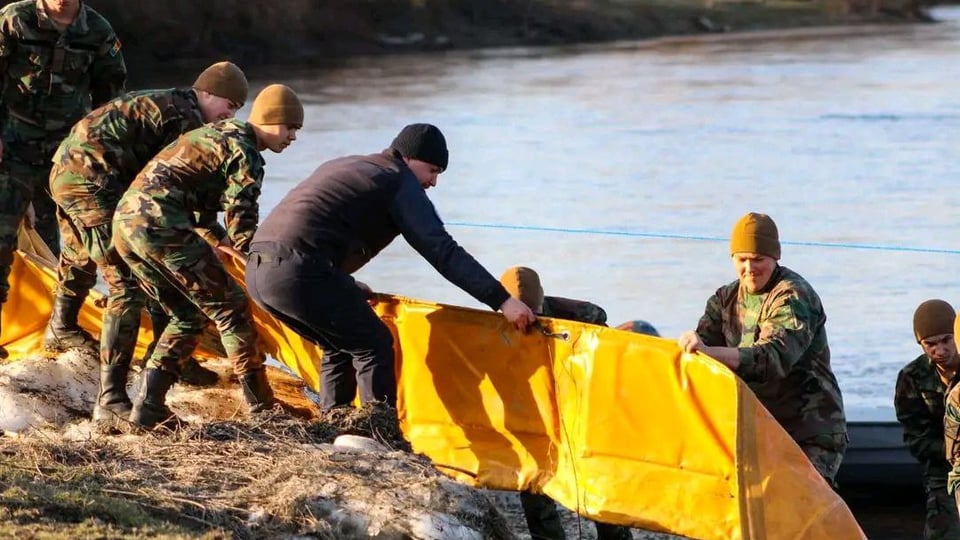
Overnight into March 7, a Russian strike on the hydroelectric complex in Novodnistrovsk led to a leak of petroleum products into the Dniester River. Within a few days, the contamination reached the northern districts of Moldova. Local authorities introduced an eco-emergency protocol, began installing barriers and filters on the river, and temporarily restricted water supply in several districts.
We explain what is known about the contamination's origin, its possible consequences, and the measures Moldova is taking.
What happened to the Dniester?
Overnight into March 7, 2026, a Russian strike on the hydroelectric complex in the Ukrainian town of Novodnistrovsk caused a petroleum product leak into the Dniester River. The first signs of contamination on Moldovan territory were recorded on March 10 near the village of Naslavcea. On March 15, the country's government introduced a state of environmental emergency in the Dniester basin for 15 days.
President Maia Sandu, Prime Minister Alexandru Munteanu, and Environment Minister Gheorghe Hajder stated that responsibility for what happened lies with Russia. Russian authorities have not commented on the accusations.
As of March 16, the oil contamination continued to spread downstream. It affected the northern districts of Moldova and, according to local outlet NewsMaker, reached the area of the Dubasari Hydroelectric Power Plant in the Transnistrian region. Moldovan authorities also reported exceeding permissible concentrations of petroleum products and aromatic hydrocarbons in the section of the Dniester between Naslavcea and Soroca.
What is known about the composition of the pollution?
In official statements, Moldovan authorities use cautious wording: “petroleum products” or “substances of petroleum origin.” As of March 16, the exact chemical composition of the contamination has not been publicly established.
Executive Director of the Eco-TIRAS River Keepers Association, Doctor of Biological Sciences Ilya Trombitsky, says that determining the type of pollutant is possible only after a full chemical analysis of the water.
“At this moment, it is unknown what this pollutant is and its source. The Ukrainians also do not know where it comes from. So paradoxically, ten days have passed, and there is no result. The first analyses for oxygen content and pH give nothing. A chemical analysis of pollutants is needed here,” Trombitsky told NewsMaker.
According to him, several scenarios are possible: a leak of gasoline or petroleum products, damage to a transformer with toxic lubricant, or, in the worst case, a hit from rocket fuel containing heptyl. The presence of heptyl in the water has not been officially confirmed.
Moldova's Environment Minister Gheorghe Hajder also stated that the volume of petroleum products that entered the river may significantly exceed the initial estimate of 1.5 tons.
“Even now the polluting substance continues to enter the Dniester, and we see that the volume of oil significantly exceeds the initially declared 1.5 tons,” Hajder said.
How dangerous is this for people and nature?
The main threat concerns drinking water. The Dniester is the primary water source for a significant part of Moldova, so authorities directly linked the state of environmental emergency to protecting public health. Due to the risk of contamination entering the water supply system, water intake was restricted in several settlements in the north of the country — near the border with Ukraine and along the Dniester channel. Among them are Naslavcea, Balti, Soroca, Floresti, and Singerei.
How dangerous the water will prove to be for people depends on the composition of the contamination. According to ecologist Ilya Trombitsky, if rocket fuel with heptyl is found in water, the situation could escalate into an environmental catastrophe. Even with ordinary petroleum products, the water cannot be considered safe without chemical analyses.
The contamination also threatens the river's ecosystem. According to Trombitsky, organisms near the shoreline and waterfowl suffer first: the oil film sticks to their feathers and can lead to their deaths. As a precautionary measure, authorities banned amateur and sport fishing in the section of the Dniester from Naslavcea to the Dubasari Reservoir.
How did the pollution spread?
Events unfolded over several days. After the March 7 strike, petroleum products entered the Dniester. By March 10, near the village of Naslavcea, the first oily spots were observed, and sampling began. From March 11 to 13, rescuers installed filters and containment barriers, on March 14, water cutoffs began, and on March 15, the government introduced the state of environmental emergency.
The oil film moved downstream along the Dniester — from the Ukrainian hydroelectric power plant through northern Moldova and further into the depths of the country. As the contamination advanced, authorities installed new barriers and protective structures. Particular attention was paid to the Vadul lui Vodă area, where the water intake supplying drinking water to Chisinau is located.
The National Crisis Management Center emphasizes that this is not a stationary spot, but a “wave” of contamination. The Dniester is a flowing river, so petroleum products move with the current, and the concentration of substances can vary from section to section.
What measures are the authorities taking?
After detecting the contamination, Moldovan authorities switched to crisis response mode. An state of environmental emergency was introduced in the Dniester basin, state structures and units of the National Army were mobilized, and an operational camp was deployed in the village of Cureșnița in the Soroca district in the north of the country.
Boom containment barriers and filters that trap the oil film are being installed on the river. Absorbent materials, including bales of straw, are used to absorb it. Additional barriers appeared in the areas of Cureșnița, Arionești, and near the Cosăuţi water intake station. Rescuers, ecologists, water management services, military personnel, and specialists from Romania are participating in the work.
To protect the water supply, water intake from the Dniester was temporarily stopped in the northern districts. Near the water intake in Vadul lui Vodă, the Apă-Canal Chișinău enterprise installed two protective dams about 50 and 60 meters long and began hourly water monitoring.
In parallel, authorities are seeking alternative water sources. In the Soroca district, seven artesian wells were prepared, in the Floresti district, underground sources began to be used, and in Bălți, plans are underway to deliver drinking and technical water.
Can pollution affect other countries?
By mid-March, Dniester contamination had ceased to be exclusively a Moldovan problem. The oil film continues to move downstream and has reached the Dubasari Hydroelectric Power Plant, spreading throughout the transboundary Dniester system.
Concerns arise because contamination could reach the river's mouth. The Dniester flows into the Dniester Estuary in southern Ukraine, and then connects to the Black Sea, so in an unfavorable scenario, petroleum products could enter the marine ecosystem.
Other countries have already joined the clearing efforts. Romania sent specialists and equipment for capturing oil contamination, and the European Union is ready to provide assistance through the EU Civil Protection Mechanism.
What is the legal assessment of the events?
Moldovan authorities call the Dniester contamination a direct consequence of Russia's war against Ukraine. Environment Minister Gheorghe Hajder stated that what happened is “not a natural accident,” but the result of a Russian attack on Ukrainian infrastructure. President Maia Sandu made a similar statement.
On March 16, the human rights association Promo-LEX appealed to the General Prosecutor's Office of Moldova, demanding the initiation of a criminal investigation. The organization believes that the event may fall under articles of the Criminal Code on water pollution and ecocide.
In the opinion of human rights defenders, this may not be just an environmental incident, but a potential transboundary environmental crime. The final legal assessment will depend on the results of the investigation and expert examinations.
This report was created with the support of RLNE.