
Can Zelenskyy's eminence grise actually end up behind bars? Inside the Yermak corruption scandal


Almost six months have passed since Andriy Yermak — Volodymyr Zelenskyy’s “eminence grise” — left his post as head of the Presidential Office amid the biggest corruption scandal in recent memory.
Yermak’s name has repeatedly been linked to the “Mindich case/Operation Midas,” but only now has he been charged — seemingly for a different episode. hromadske examined how the schemes at the state NPP operator Energoatom connect to the luxurious estates in Kyiv Oblast and what role Yermak played in them.
All roads lead to Che Guevara
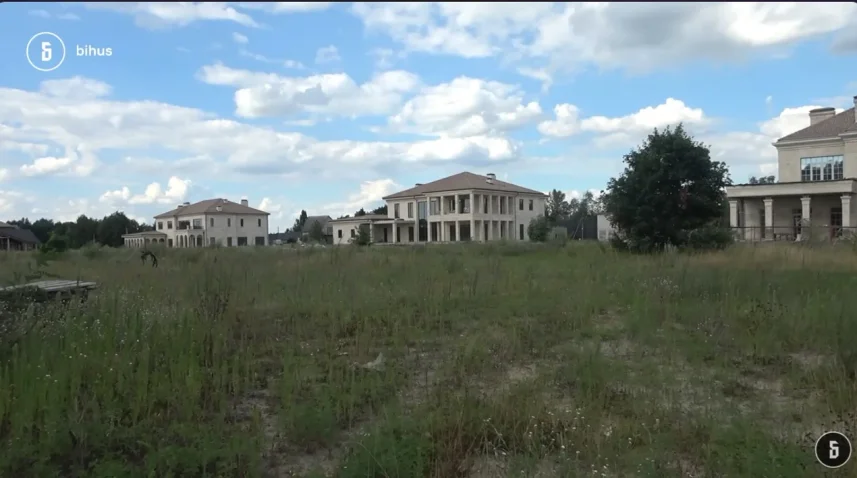
The charges against Andriy Yermak concern four estates in Kozyn near Kyiv, which have been combined into the Dynasty cooperative. Bihus.Info journalists first reported on them back in July 2025, claiming that during the full-scale invasion, the estates were built by people connected to then-Deputy Prime Minister Oleksiy Chernyshov.
News agency Ukrainska Pravda suggested that the four houses were being constructed for Volodymyr Zelenskyy, Andriy Yermak, Tymur Mindich and Oleksiy Chernyshov.
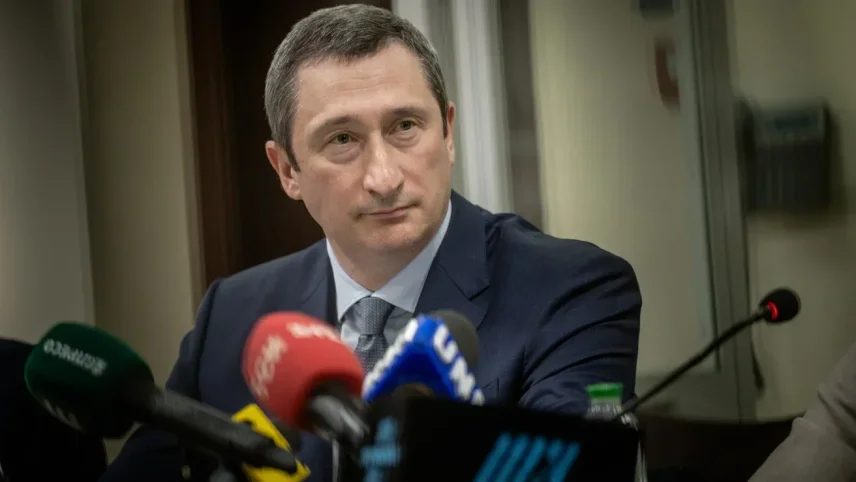
It was with Oleksiy Chernyshov that the tangle of corruption cases involving top officials began to unravel. Here is a reminder:
- In June 2025, Chernyshov was charged with bribery — the case involves receiving discounts on apartments in exchange for allowing a private developer to obtain land in Kyiv for a residential complex. Chernyshov denies these accusations.
- Before the charges were pressed, Chernyshov left on an official foreign trip and briefly caused public concern over whether he intended to return. Dzerkalo Tyzhnia reported that businessman Tymur Mindich, who later became widely known as the main figure in Operation Midas, traveled to bring the minister back from abroad.
- According to wiretap recordings, in July 2025, Mindich discussed halting construction work, explaining that if a certain figure “gets exposed in the case,” then “we are f*cked.”

- In November 2025, Chernyshov was charged on another count, this time in the Midas case. According to investigators, he was among the visitors to the “laundry” where funds obtained from the energy sector scheme were laundered. It was then that the prosecutor confirmed that on the wiretap recordings of the dealers, Chernyshov was referred to by the nickname Che Guevara.
- The SAPO prosecutor stated that figures in the Midas case discussed a proposal to take money from the “kitty” to pay bail for Chernyshov in the first apartment case.
In October 2025, it became known that law enforcement, following a journalistic investigation, opened another case against Chernyshov — regarding the Dynasty cooperative.
From Midas to Dynasty
On May 11, NABU published new wiretap recordings of the figures, which essentially confirm the journalists’ assumptions: money received from kickbacks at Energoatom could later be laundered through the construction of estates in Kyiv Oblast.
According to investigators, in 2018, Chernyshov joined the founders of Bloom Development LLC, which acquired more than 4 hectares of land from the Kozyn village council — the foundation for the future construction. Due to his status as a civil servant — at the time he was head of the Kyiv Oblast State Administration — he transferred his share in the company’s authorized capital to his wife.
In March 2020, Chernyshov headed the Ministry of Development. And, according to investigators, the concept for building Dynasty on this land was introduced as early as May.
In June of the same year, they brought in Mindich, who appears on the tapes as Carlson, and another participant — “Number 2,” none other than the head of the Presidential Office, Andriy Yermak.
Active construction began in June 2021. At that time, a commemorative capsule was buried on the site, and a dedication ceremony was even held. For this, they invited a clergyman whose wife in 2022 would become the formal owner of one of the apartments provided as a bribe to Chernyshov, NABU claims (the very apartment case).
After June 2021, active financing of Dynasty construction began, which investigators call the “legalization of funds.” According to NABU, people controlled by Chernyshov created a legal entity — the Sunny Shore housing construction cooperative — into which “clean” money was deposited. This was meant to create the appearance of a legitimate origin.
The “clean” money made up only 10 percent of the financing; the remaining 90 percent came from criminally obtained funds. Part of the cash was handed to workers through Chernyshov’s personal assistant in the Kyiv office; another part was received by Mindich’s person from an associate, investigators note.
Yet even the “clean” financing raises questions: according to investigators, related parties received funds for allegedly provided services from legal entities with signs of fictitiousness and from legal entities in the pharmaceutical sector. Earlier, law enforcement reported recording the transfer of cash from the Energoatom scheme at a certain medical clinic owned by one of the members of the criminal organization.
So what does Yermak have to do with it?
Law enforcement call the former head of the Presidential Office a member of an organized group involved in the legalization of 460 million hryvnias ($10.5 million) through the construction of Dynasty.
He was charged under Part 3 of Article 209 of the Criminal Code of Ukraine — the crime of legalization (laundering) of property obtained through criminal means. But exactly what part he played in the legalization of the funds remains unclear so far.
In the published wiretaps and correspondence, the figures discuss meetings with “Number 2” and communicate with him about design and construction work, but that is all for now. Whether this will be enough for the suspect “Number 2” to receive a conviction remains to be seen.
Law enforcement had already conducted searches of Yermak in November 2025 amid the exposure of Operation Midas. But at that time, Yermak was not charged. He submitted a resignation letter and, instead of the promised front lines, soon received a position in the Ukrainian National Bar Association and even conducts tours for Hollywood stars at the front.
Yermak’s lawyer, Ihor Fomin, considers the charges groundless: “You do not need to be a professional lawyer to ask yourself: whose money was Yermak supposed to launder in some construction project? In my view, this entire situation is provoked by this public pressure.” Yermak himself stated that he has no other housing besides one apartment.
Daria Kaleniuk, executive director of the Anti-Corruption Action Center, explains: money laundering, or legalization of proceeds from crime, consists of several elements. It involves obtaining money through criminal means and transforming that money through various operations, including investments, into real estate or something that has the appearance of legitimate income or legitimate property.
“It is precisely this that Andriy Yermak is now charged with. As for whether there was legalization or not — NABU has published accounting documents regarding the construction of the houses and part of the communications that include Andriy Yermak, where he coordinated with the designer what should be in the R2 house. That is, Yermak was aware that this house was being built for him,” she says.
Daria Kaleniuk is confident that what NABU showed on video is only a small part of the case, and other evidence, including witness testimony, correspondence, and documents, will be evaluated in court.
In addition, questions remain about who else stands behind the luxurious estates in Kyiv Oblast, which continued to be built even during the full-scale war.
Investigative journalist for Ukrainska Pravda, Mykhailo Tkach, says he obtained transcripts from the Midas case, from which he quoted conversations of Tymur Mindich. In them, in the context of construction, a certain “Vova” is mentioned, as well as “Maks Donets” — that is exactly the name of the head of personal security for President Volodymyr Zelenskyy. However, law enforcement cannot investigate the actions of the current president while he is in office, as he enjoys immunity under the Constitution of Ukraine.
“The big political question is who this ‘Vova’ is and whose fourth house was being built there? Did President Zelenskyy know about these houses, about the Dynasty cooperative, and what was his role there? Right now, this question is more in the political realm.
Zelenskyy must give an answer to what was actually happening there. Why his head of the Presidential Office, his business partner Mindich, and his deputy prime minister Chernyshov were together building such luxurious houses with money stolen from Energoatom — essentially on blood, in conditions of war. And Zelenskyy will not be able to stay silent here. In my view, he needs to do the work on his mistakes — to acknowledge that something was wrong in his personnel policy and in the policy of governing the state, in which such ‘Dynasties’ and such criminal groups became possible,” Daria Kaleniuk says.
Where did Yermak come from in the first place? (in case you forgot)
Before heading the Presidential Office in 2020, Yermak did not particularly stand out in politics. Until 2019, he practiced law for more than 20 years. In addition, a few years before the start of his political career, Yermak became involved in film production and even produced several films himself: The Fight Rules and The Limit.
“As a lawyer I worked quite a lot in the television and film industry, with many channels, production companies and majors. […] The very cooperation with these people is a great happiness and a colossal experience,” Yermak said in one interview.
And indeed, work in this sphere greatly influenced his subsequent career. One of his clients was the Inter television channel, and it was then that Yermak met its general producer. At the time that position was held by Volodymyr Zelenskyy.
The post in the Presidential Office is not Yermak’s debut in politics. For three convocations of the Verkhovna Rada — from the V to the VII — he worked on a volunteer basis, that is, unpaid, as an assistant to Party of Regions MP Elbrus Tedeyev. Though for some reason this chapter of his life is not mentioned in his official biography.
In 2019, Yermak joined Volodymyr Zelenskyy’s election campaign headquarters. After the victory he became an assistant to the president and handled international policy. That same year he was included in the National Investment Council and the supervisory board of defense conglomerate Ukroboronprom.
In February 2020, Zelenskyy dismissed head of the Presidential Office Andriy Bohdan and admitted that there were conflicts in his team that “interfere with work.” That is how Yermak came to be appointed head of the Presidential Office.
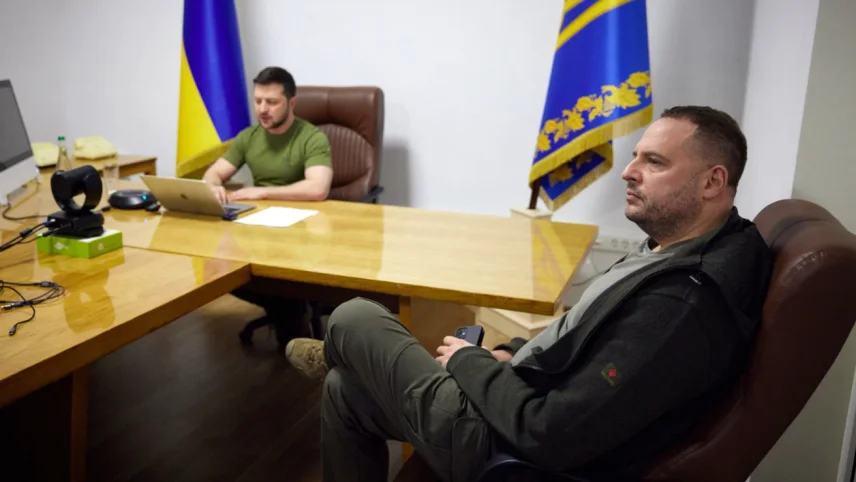
Yet less than a month after the appointment, he began to accumulate scandals. First, MP Geo Leros published video recordings on which, apparently, Yermak’s brother conducted negotiations about placing people in government positions and demanded significant sums for it.
Already in 2021, the Bellingcat investigative journalism project published an investigation into a Ukrainian special services operation to detain mercenaries from the Wagner private military company, which did not succeed. The investigators assert that it was Yermak who proposed postponing the detention of the mercenaries, which led to the operation’s failure. The accusations that Andriy Yermak could have postponed the operation were denied by Zelenskyy: “What could Yermak have authorized regarding the operation? He does not have the authority.”
From the beginning of the full-scale war Yermak continued to handle foreign policy. International visits together with the president, direct negotiations with the U.S. administration, as well as the process of returning children abducted by Russia.
But over time, lawmakers increasingly began to complain that Yermak’s influence extended not only to foreign policy but also to domestic policy.
- Share: