
“A funeral without a body is strange. But we need it”: How Ukrainians bury soldiers whose remains never came home


A dark blue funeral van stands outside St. George's Orthodox Church in Khmelnytskyi, a city in western Ukraine. A photograph of a smiling young man with dark hair is attached to its windshield.

His name is Mykola Rolia. He was 32 when he was killed in Ukraine's eastern Donetsk region on February 3, 2023.
His body has never been recovered.
On the passenger seat of the funeral van sits a ceramic urn. It contains no ashes. Instead, Mykola's wife has carefully chosen several objects to represent the husband and father she lost.
Since December 2024, Khmelnytskyi has held symbolic funerals for fallen Ukrainian soldiers whose remains cannot be returned to their families. It is currently the only Ukrainian city offering such burials.
For families who have spent years waiting, the ceremonies provide something the war has denied them: a grave to visit, a place to mourn, and a way to say goodbye.
“They shot him”
Mykola's wife, Yuliia, was pregnant with their second daughter when her husband received a military summons in December 2022.
The notice had been left on a fence outside a family home where Mykola had not lived for years. Under the rules in force at the time, it had not been properly served.
He could have ignored it. Instead, he traveled to collect the summons and began preparing to join the military.
"He didn't even think about whether to serve or not," Yuliia recalls. "He said the guys at the front needed to be relieved."
Mykola had tried to enlist at the beginning of Russia's full-scale invasion, but was turned away because he lacked military experience. He continued working as a truck driver, transporting supplies from abroad for Ukrainian troops.
On December 27, 2022, his family saw him off to a military recruitment center. He was sent to Zhytomyr for training and, a month later, deployed with Ukraine's 46th Airmobile Brigade to the Bakhmut area of Donetsk region.


- Mykola Rolia's wife and eldest daughter with a hromadske journalistpublic
- Family photos of Mykola Roliapublic
- Family photos of Mykola Roliapublic
- Family photos of Mykola Roliapublic
- Family photos of Mykola Roliapublic
- Family photos of Mykola Roliapublic
On February 2, he told Yuliia he was leaving for training and would be out of contact for several days.
In reality, he was heading out on his first combat mission.
He was killed the following day.
Yuliia gave birth to their second daughter on February 9, six days after her husband's death.
At first, the military reported Mykola missing in action. Two months later, a fellow soldier who had been released from Russian captivity visited the family and described what had happened.
According to his account, Mykola and two other soldiers had been sent on a mission near the village of Vasiukivka. One was wounded and managed to evacuate. Mykola and another soldier remained in a trench, where they were discovered by Russian Wagner mercenaries.
The mercenaries threw a grenade into the trench, injuring Mykola's leg. The witness said they then fired approximately 30 rounds into him.
"They shot him," Yuliia says, recounting the soldier's testimony.
The other soldier was taken prisoner. Before being captured, he had covered Mykola's body with his military jacket.
Yuliia believes her husband's remains may still lie beneath the earth at the site of the fighting, now under Russian occupation.
"We even have the geolocation of where it happened," she says. "There was very heavy artillery fire. I think his body remained there, buried under the ground."


- Farewell to a heropublic
- Farewell to a heropublic
- Farewell to a heropublic
A summons, a piece of clothing and soil from home
For years, Mykola was officially listed as missing.
In 2023, Yuliia found a photograph of his military identification document on Russian-linked online channels, accompanied by a statement that a man with those details had not been taken prisoner.
Eventually, she went to court to have her husband legally declared dead.
She obtained notarized testimony from the fellow soldier who had witnessed his final moments. A court ruling reviewed by hromadske records the witness's account that Mykola had been wounded, questioned by Russian forces and shot in the trench.
In August 2026, Yuliia received her husband's death certificate.
That was when she was offered the possibility of a symbolic funeral.
The Khmelnytskyi city authorities covered the organizational and financial costs. Yuliia was asked only to select objects small enough to fit inside an urn.
"I cut a small piece of fabric from the tracksuit he was wearing when he was getting ready to go to the recruitment center and later went to training in Zhytomyr," she says.
"I also gave them soil from our yard, where we lived for 12 years. And his summons, a cross and an icon."
Those objects would take the place of ashes.


- Farewell to a heropublic
- Farewell to a heropublic
- Farewell to a heropublic
- Farewell to a heropublic
- Farewell to a heropublic
- Farewell to a heropublic
How the funerals began
The idea of symbolic burials emerged after families of fallen soldiers approached the Khmelnytskyi municipal funeral service.
Their loved ones' bodies had not been recovered, and they wanted somewhere in the local cemetery to commemorate them.
The city built a columbarium wall beside its Alley of Glory, where fallen service members are buried. Its niches can hold either cremated remains or urns containing personal belongings and other symbolic objects.
"There are essentially no restrictions," says Serhii Bortnyk, head of the municipal funeral service. "You can put anything inside, except food products and explosive items."
The first ceremony took place in December 2024, when eight service members were commemorated. Five of the urns contained no ashes.


- Columbarium wall near the Alley of Glory at the cemetery in Khmelnytskyipublic
- Columbarium wall near the Alley of Glory at the cemetery in Khmelnytskyipublic
The father of Aliona Kushnir-Novitska, a combat medic killed in the bombed underground facilities of the Azovstal steel plant in Mariupol, placed her first medical coat and favorite sandals in her urn.
The family of Azov soldier Oleksii Cherniavskyi, whose vehicle was struck by an aerial bomb during the evacuation of wounded troops in Mariupol, placed his flag inside. His personal belongings had either burned or remained in occupied territory.
The wife of Azov reconnaissance sniper Oleksii Yanin placed a vessel containing water from the Sea of Azov in his urn.
Yanin was killed by a missile strike in April 2022 while crossing the Kalmius River by boat. His body remained underwater.
The Kalmius flows into the Sea of Azov.
“We envy those who can bury their loved ones”
Tetiana Demchuk does not know what happened to the remains of her son Bohdan, a 26-year-old Azov soldier killed in Mariupol in late April 2022.
His vehicle came under fire while he and his fellow soldiers were transporting a generator to an underground military hospital.
Later, the family learned that Russian forces had also shelled some of the refrigerated trucks holding the bodies of the dead.
"We haven't lost hope," Tetiana says. "We still hope we'll be able to have even a small fragment of his remains."
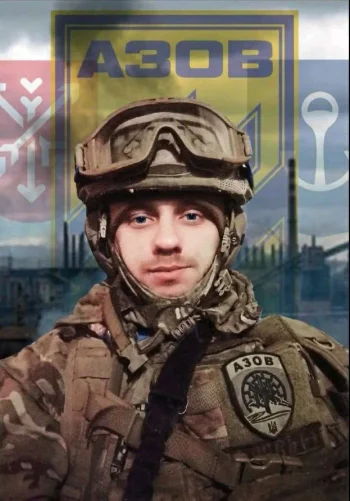
She has spent nearly five years waiting for Bohdan's remains.
She is also waiting for her younger son, Oleh, to return from Russian captivity.
Both brothers served in Azov and defended Mariupol. Oleh was taken prisoner in May 2022 after Ukrainian forces were ordered to surrender.
Tetiana says she might still have refused to believe Bohdan was dead if his younger brother had not told her what happened.
For Bohdan's symbolic funeral, she placed one of his socks in the urn.
Her daughter-in-law had kept a pair that Bohdan had left behind during his last visit home.
"Nadia found a pair of socks he hadn't taken with him," Tetiana says. "I begged her for one for the funeral. Because he'd worn it. He'd touched it. His energy was in it."
She also included a package prepared by Azov's patronage service: soil collected from different Azov training bases near Mariupol.
For Tetiana, the importance of the burial is difficult to explain to someone who has never experienced such a loss.
"To be frank, people who cannot bury their loved ones even envy those who can," she says.
"Because it's hard not to have a place where you can come and cry, where you can listen to the flags fluttering above the graves."
In the beginning, she says, she cried her bitterest tears at home, in different corners of the house.
The burial also matters to Bohdan's son, Mykhailo, who was five when his father died.
Before the funeral, the boy often asked his mother or grandmother to take him to the memorial displays bearing photographs of fallen local residents in central Khmelnytskyi.
"A child is told that his father has died. But it's not that simple, because Dad was there, and now he isn't," Tetiana explains.
"Now he comes either to the memorial or here, to the columbarium wall, and understands: here he is."

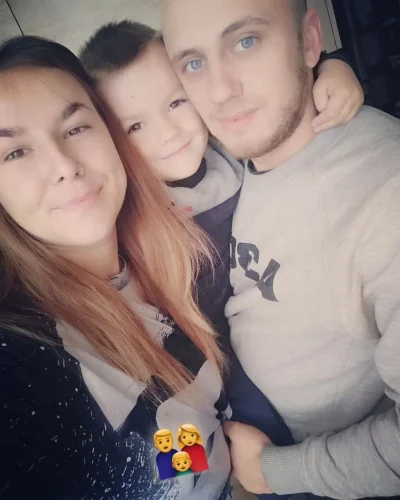





- Bohdan Demchuk with his wife and sonFrom the Demchuk family archive
- Bohdan Demchuk with his wife and sonFrom the Demchuk family archive
- Bohdan Demchuk's wife and son near his portrait on symbolic "cubes" in the center of KhmelnytskyiFrom the Demchuk family archive
- Bohdan Demchuk's wife and sonFrom the Demchuk family archive
- Bohdan Demchuk's wife and sonFrom the Demchuk family archive
Why the church agreed
Symbolic funerals presented an unusual question for the Orthodox Church of Ukraine.
How do you conduct a funeral when there is no body?
Father Oleksii, a priest at St. George's Church, says the service is almost identical to an ordinary funeral.
"The funeral service when there is a body and when there isn't one is about 90% the same," he explains.
The main difference is that certain prayers and Gospel readings normally performed over the body are omitted.
Father Oleksii points to the Orthodox Christian principle of oikonomia, which allows flexibility in applying church rules under exceptional circumstances.
"When unusual situations arise, the church accommodates them," he says.

"The church has to create new rites and new rules. Because we cannot ignore either the people who defended the country and died, or their loved ones who need consolation."
For Mykola's sister, Valentyna, the ceremony is especially important because he left behind two children.
"Now they'll have somewhere to go and remember their father," she says.
"Of course, many people didn't understand it, because a funeral without a body is strange. But it's very important for the children."


- Farewell to a heropublic
- Farewell to the deceased Mykola Roleapublic
- Farewell to the deceased Mykola Roleapublic
A farewell with full military honors
The ceremony begins at church, where the family gathers around the urn for a memorial service led by a military chaplain.
A funeral procession then travels through central Khmelnytskyi to the cemetery, accompanied by music.
People along the route kneel to honor the fallen soldier.
At the Alley of Glory, a military band plays Ukraine's national anthem. An honor guard fires three volleys of blank ammunition.
After a final brief religious service, the urn is placed inside a niche in the columbarium wall, which is then sealed with a memorial plaque.
The ceremony resembles a traditional military funeral in almost every respect.
The difference is what lies inside the urn.
For Tetiana, the decision to bury Bohdan symbolically was deeply personal.
"If someone judges me, I don't care," she says. "They would have to go through what I went through to understand what this means to me."
"But now I have somewhere to come, and my grandson knows where his father is."
A place to mourn, even as the waiting continues
For now, Khmelnytskyi is the only Ukrainian city conducting these symbolic military burials.
Because the ceremonies are funded by the local budget, they are available to families from the Khmelnytskyi community, as well as to families displaced by the war who are officially registered there.
As of early November 2026, the columbarium wall held 27 burials, 14 of them without ashes.
One urn containing symbolic objects had already been removed after the family finally received the remains of their son.
The symbolic funeral had not ended their wait.
For the other families, the uncertainty continues. Some still hope their loved ones' bodies will be recovered from occupied territory. Others wait for news of relatives held in Russian captivity.
But now they have somewhere to bring flowers, somewhere to stand in silence, somewhere to remember.
And somewhere to grieve.
- Share: