
‘We found our wives’: How Ukrainian women are building families without romance


Two women, two children, one home - and one ex-husband.
When Iryna Tarasova and Iryna Smetanska moved in together in a small town in central Ukraine, they had an unusual connection: both had been married to the same man, and each had a child with him.
"A common enemy brought us together," the women joke.
Today, they share household chores, split utility bills and help raise each other's children. They describe their arrangement as a "Boston marriage" - a form of shared domestic life between women who are not romantically involved.
They are among a growing number of Ukrainian women exploring such partnerships. Some are looking for someone to share childcare and expenses. Others have found a kind of family that goes beyond conventional friendship.
Women are finding prospective housemates and partners online, while volunteers are working on a dedicated matchmaking app.
Hromadske spoke with three pairs of women about what happens when friendship becomes a household - and what it takes to make the arrangement work.
Two ex-wives, one household
Iryna Smetanska spent six years living in Estonia. In September 2025, she separated from her husband and returned to Ukraine with their four-year-old daughter.
She says she later learned that he had taken legal action seeking sole authority over decisions about where their child would live.
One of the first people she contacted was her husband's former wife, Iryna Tarasova, a lawyer who had also been involved in legal disputes with him.
"She was the only person who understood what I was talking about without explanations," Smetanska recalls.
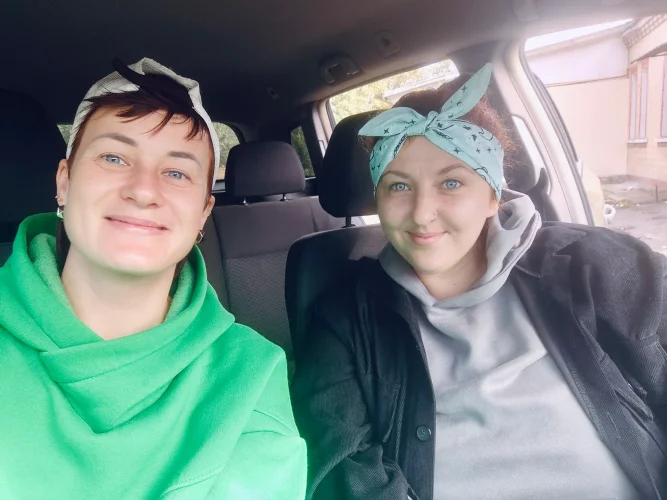
As Russian attacks on Kyiv intensified, Tarasova invited her to stay at her house in a town in Vinnytsia Oblast, central Ukraine.
"I have a house. There's room for everyone. We're not strangers, after all," she told her.
Their domestic routine developed almost without discussion. One cooks, the other cleans. They split utility bills equally, while grocery shopping is more informal: whoever goes to the store buys what is needed.
Tarasova, who has a teenage son and works long hours, says the arrangement has transformed her everyday life.
"I've gained three kilograms," she laughs.
Before Smetanska arrived, she and her son lived "more like bachelors," she says. Now there is food at home, someone checks when her son returns and whether he has done his homework, and she sometimes takes homemade pancakes or potato fritters to work.
Her colleagues have embraced the arrangement.
"They say, 'Oh, great! Say hello to your Boston wife. She cooks really well.'"
The two women have different temperaments — one describes herself as a hurricane, the other is calmer — but say they have learned how not to escalate disagreements.
They also recognize that sharing a home means making room for another person with her own habits and expectations.
"If you're used to being the woman of the house, can you tolerate another one in your territory?" Tarasova asks.
Their neighbors were less surprised by two women living together than by the fact that they had married the same man.
Smetanska says some people approve, while others remain silent.
"During World War II, women also lived together while their husbands were at the front," she says. "But ours only fights with us."
Neither woman sees the arrangement as necessarily permanent. They have discussed moving abroad together, although they have yet to agree on one important detail: one prefers a warm climate, the other a cold one.
A new partner - and permission to dent the car
For Tetiana and Viktoriia, the decision to share a home began with an online advertisement.
Both were mothers of very young boys and were looking for another woman with a child. The idea was practical: take turns looking after the children, divide household responsibilities and make it easier to work.
After just a few weeks of messaging, Tetiana traveled across Ukraine with her 11-month-old son to stay with Viktoriia, whose own boy was one year and three months old.


- Tatyana and VictoriaProvided by hromadske
- Tatyana and VictoriaProvided by hromadske
Viktoriia sent her the entry codes to her apartment so the visitors could arrive from their overnight train and go straight to sleep.
They met face-to-face the following morning.
"It was as if we'd known each other for a long time," Tetiana says.

Both women had experienced relationships with men in which they felt disrespected. Their new partnership offered a different kind of support.
Tetiana, who has a driver's license but little experience behind the wheel, recalls how Viktoriia encouraged her to drive a car left to her by her father.
"She says, 'It's fine if something happens. The car is old,'" Tetiana explains.
Rather than warning her how expensive it would be to repair a scratch, Viktoriia reassured her.
"Vika basically gave me permission to wreck the car right at the beginning," Tetiana jokes.
The women had lived together for only a week when they spoke to hromadske, but they were already looking for housing that would suit both of them.
Tetiana works as a hairdresser outside the home, while Viktoriia makes jewelry at home. They hope their complementary schedules will help them share childcare.
They have also taken a trip to the mountains together — a kind of compatibility test — and plan to travel abroad with their children to see how the boys get along.
Tetiana's advice to other women considering a similar arrangement is simple: don't be afraid of what people might say.
Four years together: 'Deeper than friendship'
For Olena and Olha, what began as an unlikely friendship has become a family.
They have lived together for more than four years, raising their sons under the same roof in Poland. Both women are married to men with whom they remain in regular contact.
They first encountered each other on an online forum for pregnant women. Their sons were born just two days apart.
They were not particularly close until Olena jokingly suggested a five-day hiking trip in the Carpathian Mountains.
On their first night camping, they heard footsteps outside their tent.
"Olena jumped out with a big knife her husband had given her," Olha recalls. "I really wanted to sleep, but I couldn't leave her alone. So I jumped out with a tent pole."
That night, they realized they could rely on each other.


- Olena and Olga call each other familyProvided by hromadske
- Olena and Olga call each other familyProvided by hromadske
- Olena and Olga call each other familyProvided by hromadske
In February 2022, shortly before Russia launched its full-scale invasion of Ukraine, Olena traveled to Poland for a vacation and ended up staying there.
In March, she invited Olha to join her from Kyiv.


- Olena and Olga call each other familyProvided by hromadske
- Olena and Olga call each other familyProvided by hromadske
- Olena and Olga call each other familyProvided by hromadske
When Olena sought accommodation for her friend in Kraków, she was told there was no room left for new arrivals.
So she improvised.
"I blurted out, 'But it's my sister who's coming! She needs to be accommodated in Kraków so she can be close to me.'"
The story stuck. Even at their children's school, people believe the women are sisters.
At first, the two did almost everything together, including taking the children to kindergarten.
Then someone asked why both of them needed to go.
They realized they could save time by dividing the work: one could drop off the children, the other pick them up. One could cook while the other cleaned.


- Previously, Olena and Olga did not know what a Boston marriage was.Provided by hromadske
- Olena and Olga call each other familyProvided by hromadske
- Previously, Olena and Olga did not know what a Boston marriage was.Provided by hromadske
But living together has not been entirely free of conflict.
Olha recalls once getting angry because Olena took out the trash after Olha had said she would do it.
"When you think of yourself as the woman of the house and someone takes a task away from you, you start wondering whether she doesn't trust you," she says.
Then she reconsidered: the whole point was to get the trash taken out.
Their sons have also had to learn to live together. Today, the boys "fight like brothers and are friends like brothers," the women say. Earlier, they threatened to draw a line down the middle of their room to mark their respective territories.
Over the years, the families have grown closer. Olena's parents take both boys for overnight stays, while Olha's mother sends Olena her favorite homemade jam.
The women have supported each other through everyday difficulties, family deaths and periods of depression.
This spring, Olha was diagnosed with cancer.
Olena accompanied her to chemotherapy appointments and helped her get home afterward.
"It's good to have someone who will drive you there and back, who will support you," Olha says.
"Olena would pick me up after chemotherapy, and we'd go get shawarma. You're focused on not dying, and then there's someone who brings your focus back to living."
The women still speak to their husbands daily and discuss decisions involving their children. Both hope to reunite with their spouses, although they know that living together again after years apart will require another period of adjustment.
For now, they consider each other family.
Olha says the strength of their partnership lies in communicating openly, respecting each other's differences and allowing one another time alone.
"To me, the most important thing is genuine support," she says. "The foundation of our relationship is wanting what's best for the other person, caring about her, while recognizing her right to be different from you."
"This connection and level of support go beyond simple friendship."
What is a Boston marriage?
The term Boston marriage dates back to the late 19th century, when it was used to describe two women living together in a long-term, financially independent domestic partnership, often outside conventional marriage.
Historically, such relationships could take different forms, and some involved romantic intimacy. The Ukrainian women interviewed by hromadske, however, describe their arrangements as non-romantic partnerships built around mutual support, shared responsibilities and companionship.
For some, these households provide a practical response to the pressures of work, childcare and displacement. For others, they have become something much more personal: a family they chose and built together.
- Share: